A postdoc (or "post-doc," "postdoctoral," or "postdoctoral research") fellowship is a training-focused position available to people who have earned a doctorate. Postdoc positions usually act as a stepping-stone between the student experience and the full-time professional experience.
Postdoc: expected to begin in Sep/Oct 2025
University of Oxford, UK, 2025 to 2026, Prof Mentor: Peter Keevash
University of Bonn, Germany, 2026 to 2028, Prof Mentor: Lisa Sauermann
The Scott Russell Johnson Achievement awards were established in 2001 by Steve and Rosemarie Johnson in memory of Steve's brother Scott who graduated in Math from Caltech in 1983.
The Scott Russell Johnson Prize for Excellence in Graduate Study is given to continuing graduate students for extraordinary progress in research and excellence in teaching, or excellent performance as a first-year graduate student. The Scott Russell Johnson Graduate Dissertation Prize in Mathematics is awarded for the best graduate dissertation in mathematics.
Johnson Prize for Excellence in Graduate Study
2022 - Jeck Lim
2021 - Forte Shinko
2020 - Tamir Hemo, Sunghyuk Park, Lingfei Yi
2019 - Josh Frisch, Liyang Yang
2018 - Dmitri Gekhtman, Liyang Yang
2017 - Cosmin Pohoata, Luciena Xiao
2016 - William Chan, Marius Lemm
2015 - Peter Burton, Dmitri Gekhtman, Marius Lemm
2014 - Serin Hong, Marius Lemm, Maria Nastasescu
2013 - William Chan, Liubomir Chiriac, Marius Lemm
2012 - Maria Nastasescu, Robin Tucker-Drob, Tony Wong
Undergrad Institution: Cambridge University
Major: Math
BA and MMath (in progress)
GPA for BA: 96%
GRE Revised General Test (taken in Sep 2019):
Quantitative Reasoning: 170 (96%)
Verbal Reasoning: 159 (83%)
Writing: 4.5 (81%)
GRE Subject Test (taken in Sep 2019):
Mathematics: 970 (99%)
Program Applying: Pure Math PhD
Applied to:
Caltech: Accepted on 4 Feb, Attending!
Cambridge: Accepted on 12 Feb, Declined on 6 Mar
MIT: Waitlisted on 6 Feb, Rejected on 15 Apr
Princeton: Rejected on 31 Jan
Stanford: Waitlisted on 2 Mar, Rejected on 10 Apr
Yale: Accepted on 3 Feb, Declined on 11 Apr
Deadline for acceptance of US grad schools: 15 Apr
There are 50 teams from 25 universities and 10 countries taking part in this contest. The list of teams are here.
The 5-hr contest has just started at 0900 hrs Singapore time. You may watch the lives scoreboard here. Lim Li is in the official team 3NationsIOI with team mates Agus Sentosa Hermawan and How Si Wei,
The open contest scoreboard is here. Lim Jeck is in unofficial team Jacob Teo with team mates Jacob and Choong Yin.
~~
Update: Final Results
Top 20:
The Northwestern Europe Regional Contest (NWERC) is a contest in which teams from universities all over the Northwestern part of Europe are served a series of algorithmic problems. The goal of each team is to solve as many problems as possible within the 5 hour time limit. Potential solutions are submitted and corrected by an automated judging system. The team that solves the most problems at the end of the contest qualify for the ICPC World Finals.
NWERC 2018 is held in Eindhoven, Netherlands, from 23 - 25 November.
Cambridge has sent the following 4 teams to NWERC 2018:
Me[♠]talci
Prime Goal
Treenity (Lim Jeck is in this team!)
Triniceratops
Top 10 results is below. Members of top 4 teams win a Huawei P20 each.
Team Treenity from Cambridge has won the contest! David Wärn, Lim Jeck and Zoltán Molnár Sáska will be going 2019 ICPC World Finals which will be held in Porto, Portugal. Teams will arrive on 31 March 2019 and depart on 5 April 2019 with the World Finals being held on 4 April 2019.
Teams of Trinity Computer Science and Maths students scooped first, second and third place in the UK/IE Programming Contest out of over 150 teams from across the UK and Ireland.
The annual competition – held at several UK and Irish universities – aims to help universities select teams to attend the Northwestern Europe Programming Contest later this autumn. These competitions are designed to test students’ programming skills, problem solving and team work.
Each team comprises three students who try to solve as many problems as possible from a given problem set, using one computer.
Trinity Fellow, Professor Frank Stajano, said:
This was an amazing result. Out of all the 150+ undergraduate teams that took part, the top four places went to Cambridge and, of these, the best three teams in UK and Ireland are from Trinity!
In first place was the Triniceratops team, with Kacper Walentynowicz, Paweł Burzyński and Mariusz Trela.
In second place, team Treenity, with David Wärn, Jeck Lim and Zoltán Molnár Sáska.
In third place, team Me[♠]talci, with Dimitrije Erdeljan, Dušan Živanović and Vladimir Milenković.
Trinity teams hard at work during the contest
Kacper Walentynowicz, who captained Triniceratops, said it was a ‘one-of-its-kind experience to wake up as UK and Ireland Programming Contest Champion.’
Such competitions are normally very stressful, said Kacper. ‘There are millions of things that can possibly go wrong during the competition and they usually prevent you from just having fun. However, this time everything went so smoothly for us that we didn’t feel uncomfortable at all (maaaybe at the very beginning only).’
Kacper and his peers – the Triniceratops team was Polish – have taken part in programming competitions before and found that it’s not all about winning.
It is not success that motivates you to push yourself but the pleasure of solving interesting challenges and stretching your brain.
That was also true this time – winning is cool, but if it was just about winning, I wouldn’t delve into programming. It’s just fun from the beginning till the end.
Other Trinity computer science students who took part, did well, said Professor Stajano, who founded the Inter-ACE and Cambridge2Cambridge cyber security competitions, the latter in collaboration with MIT.
‘Cambridge has always been a worthy force in competitive programming, but such strong performance from a single College has never been seen before. In particular, Triniceratops should be highly commended for achieving a full score – 12 out of 12 problems solved,’ he said.Trinity PhD student, Petar Veličković, a former competitor-turned-organiser, said that hosting the Cambridge site for the competition this year was challenging but very rewarding.
I am hopeful that our teams will repeat this outstanding performance at the Northwestern Europe regionals, which would qualify an all-Trinity team for the ACM-ICPC World Finals for a second year in a row.’
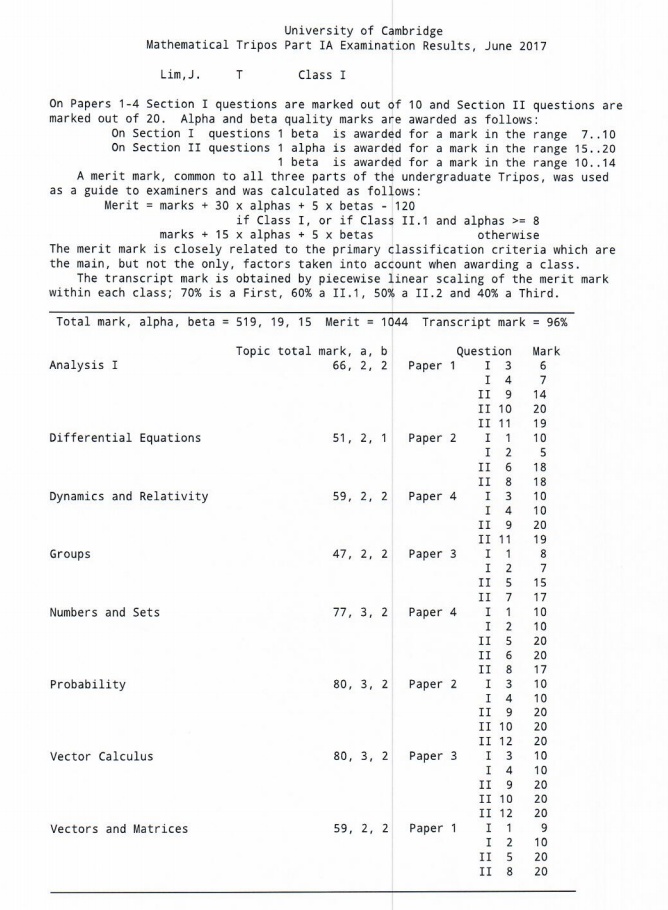
Top 4 in Cambridge Mathematical Tripos Part IA are Warren Li, Andy Zhao, Lim Jeck and Alex Gunning.
All 4 are from Trinity College.
Out of about 250 Math Tripos Part IA students in Cambridge, 75 obtained Class 1 (70% and above) i.e. First Class.
Trinity College awards a prize of £240 to her students who have achieved a First in Part IA of the Mathematical Tripos. For Senior Scholars (top few among the First), there is an additional award of £250 and some meal allowance which is about £74.
Cambridge has 3 terms in a year: Michaelmas Term, Lent Term and Easter Term. There are no exams in the first two terms; all academic exams are held during the last term.
Lim Jeck's Supervisors' Report for Michaelmas Term is below, to give readers a feel of how a Supervisor report looks like. I won't be posting subsequent Supervisor reports.
(Estimate of term's work: 1 means Class 1)
Mathematical Tripos, Part IA Trinity
Module: Differential Equations
Supervised by Mr Gunnar Peng (GGP24)
Industry: Good
Progress: Good
Interest: Enthusiastic
Estimate of
term's work:
1
Comments: Outstanding work! Solved essentially every problem, but with a few minor mistakes.
Module: Vectors and Matrices
Supervised by Mr Matthew Crowe (MC756)
Industry: Good
Progress: Good
Interest: Interested
Estimate of
term's work:
1
Comments: Near perfect answers to all questions, well done. Is interested but quite quiet in
supervisions.
Modules: Numbers and Sets, Groups
Supervised by Professor I.B. Leader (IBL10)
Industry: Good
Progress: Good
Interest: Enthusiastic
Estimate of
term's work:
1
Comments: A fantastic start to his Cambridge career. He has done a lot of hard questions: has his
own particular (and very effective) way of approaching problems. A real star.
Bright and interested: a pleasure to supervise.
Cambridge University's terms are rather short. There are 3 terms: Michaelmas term (9 weeks), 6-week break, Lent term (9 weeks), 6-week break, Easter term (8 weeks, mainly revisions followed by year-end exams) then 3.5-month break. Effectively, undergraduate students only attend lessons for about 18 weeks in a whole academic year!
Lim Jeck was back home for holiday break, from 4 Dec 2016 to 15 Jan 2017. He will be back again on 19 Mar 2017.
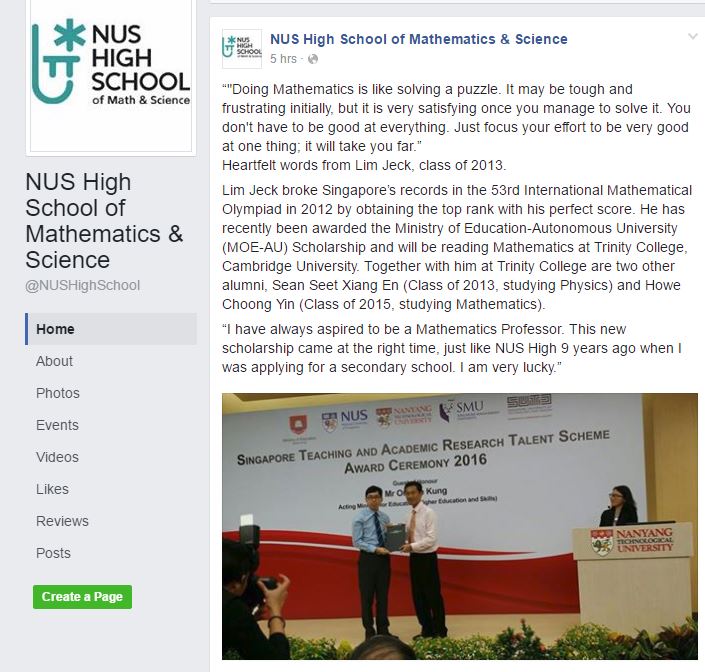
The Singapore Teaching and Academic Research Talent Scheme (START) supports young Singaporeans interested in pursuing an academic career at our Autonomous Universities (AUs), and aims to help our AUs build up their pool of academic talent in both research and teaching. START provides a suite of scholarships and support options for undergraduates, postgraduates, and PhD holders interested in academia.
At the undergraduate level, the MOE-AU Scholarship sponsors students’ undergraduate studies at local or overseas institutions, and recipients receive tailored academic mentorship and developmental opportunities from their paired AU. At the postgraduate level, selected postgraduate faculty development schemes support outstanding students as they pursue PhD and postdoctoral programmes at top overseas institutions, before returning to serve at our local AUs. For PhD holders, Early Career Awards allow aspiring academics to gain valuable teaching and research experience at the AUs, with the objective of helping them to establish a competitive portfolio for their future application and appointment as faculty members at our AUs.
In all, 20 students received scholarships from Acting Minister for Education (Higher Education and Skills) Mr Ong Ye Kung at the START Award Ceremony today. The list of scholarship recipients can be found here.


.jpeg)